
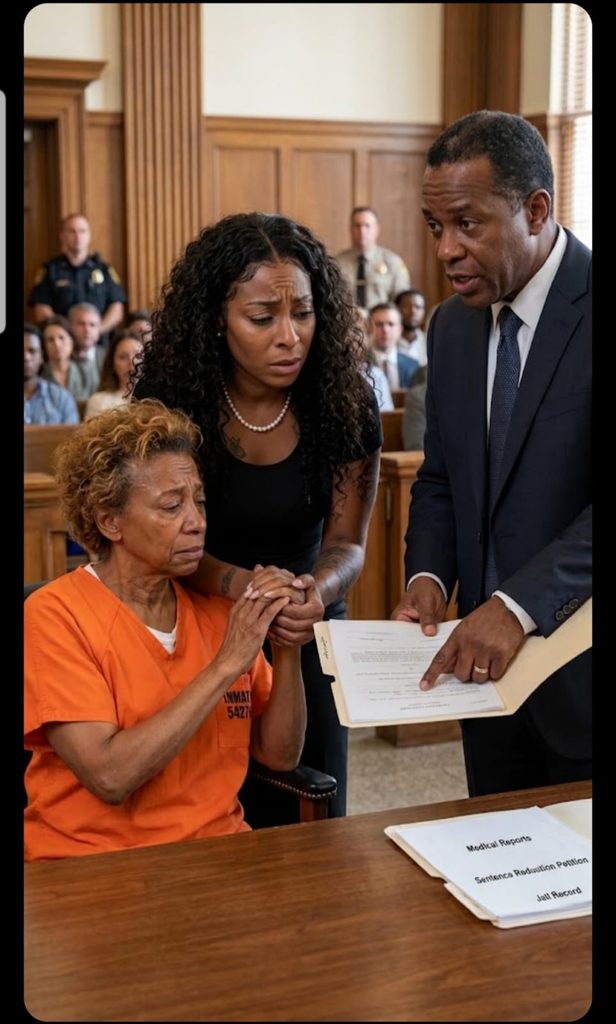
The Morning of the Hearing
The federal courthouse was unusually quiet that morning. Outside the building, people moved through the entrance with folders, briefcases, and serious expressions, but inside the courtroom, every movement seemed slower and more deliberate. The case before the court involved a woman in her early sixties who was serving a six-year federal prison sentence for a drug-related offense. Her legal team had submitted a request for compassionate release, asking the court to consider whether her age and documented medical problems justified a reduction in her sentence.
Sitting close to her mother was Sharra. She had spent much of the morning trying to remain calm, but the importance of the hearing was impossible to ignore. She knew that this was not simply another legal appointment. This was a moment that could affect her mother’s future and determine whether she might be allowed to return home earlier than expected.
Sharra gently held her mother’s hand. The gesture was simple, but it communicated everything she could not easily put into words. Her mother felt the pressure of the hearing, while Sharra tried to give her the confidence to keep going.
A Daughter’s Support
Sharra looked toward her mother and noticed how emotionally exhausted she appeared. The years of separation, the uncertainty surrounding her sentence, and her documented health problems had taken a visible emotional toll. Yet her mother remained dignified. She sat quietly, listening carefully and waiting for the court to hear the arguments supporting her request.
Sharra’s expression revealed a mixture of worry and determination. She was deeply concerned about her mother’s health, but she did not want her mother to see her break down. Instead, she squeezed her mother’s hand gently, reminding her without words that she was not facing the hearing alone.
Her mother looked back at her for a brief moment. There was concern in her eyes, but there was also a small sense of hope. For the first time that morning, the tension between them seemed to ease slightly.
The Attorney Presents the Request
Standing beside them was their attorney. The lawyer carried a thick legal folder containing medical records, prison records, supporting statements, and other documents prepared for the court. The attorney understood that the request had to be presented carefully and respectfully.
When the hearing began, the attorney explained that the request was based on several documented circumstances. The first consideration was the woman’s age. The second involved her medical problems, which had been documented through records submitted to the court. The third involved concerns regarding her declining health while serving her sentence.
The attorney emphasized that the request was not asking the court to ignore the original offense. Instead, the legal team was asking the judge to consider the woman’s current circumstances and whether a sentence reduction or compassionate release was legally appropriate.
The Judge Reviews the Evidence
Behind the bench, the federal judge listened carefully. Several documents were placed before the court, and the judge reviewed them one by one. The courtroom remained quiet as the legal arguments continued.
The judge did not immediately announce a decision. Instead, the court continued reviewing the information presented by the attorney. The medical records were especially important because they documented the health concerns that formed part of the request.
Sharra watched the judge carefully. She knew that every page being reviewed represented another part of her mother’s situation. She tried to read the judge’s expression, but there was no clear indication of what the final decision would be.
Her mother remained composed. She occasionally glanced toward Sharra, and each time Sharra responded with a reassuring look. Neither woman knew what would happen next, but they understood that the court was giving the request serious consideration.
The Government Responds
Across the courtroom, a government prosecutor carefully reviewed the request and the documents submitted by the defense. The prosecutor’s role was to present the government’s position concerning the request and respond to the arguments made by the defense attorney.
The prosecutor examined the medical documentation, the prison records, and the legal arguments. The courtroom remained professional and orderly as both sides addressed the court.
Sharra understood that this was part of the legal process. She knew the decision would not be determined simply by emotion. The judge had to consider the law, the evidence, the circumstances surrounding the sentence, and the information presented by both sides.
Even though the uncertainty was difficult for her, Sharra continued standing beside her mother. She did not move away. Her hand remained gently connected to her mother’s, providing quiet reassurance during every moment of the proceeding.
A Difficult Moment for Sharra
As the discussion continued, Sharra’s emotions became harder to control. She looked at her mother and remembered how different their lives had become since the sentence began. There had been missed family moments, difficult phone calls, uncertainty, and countless days when Sharra could only wonder how her mother was doing.
Seeing her mother sitting inside the courtroom made those memories feel immediate again. Sharra wanted nothing more than to see her mother outside the prison system and back with the family. At the same time, she understood that the court had to make its decision based on the legal record.
She took a slow breath and remained composed. Her mother noticed the emotion on Sharra’s face and gave her hand a gentle squeeze in return.
Those two words affected Sharra deeply. She had come to court believing that she needed to be the strong one, but suddenly she realized that her mother was also trying to protect her emotionally.
The Courtroom Waits
A court clerk moved quietly through the room, organizing paperwork while the U.S. Marshal remained naturally positioned in the courtroom. The atmosphere was serious but controlled. Everyone understood the significance of the proceeding.
The judge continued examining the information before the court. The attorney remained ready to answer questions or clarify any part of the request. The government prosecutor continued reviewing the submitted materials.
Sharra’s mother sat quietly, appearing tired but dignified. Her face reflected the uncertainty of someone waiting for an important decision. There was no celebration and no sense that the outcome had already been determined.
The court was still considering the request. No release had been granted. No final announcement had been made. The legal process was still unfolding.
Hope Without Certainty
For Sharra, the most difficult part was the uncertainty. She wanted to believe that the court would recognize her mother’s age and medical circumstances, but she knew that hope could not guarantee an outcome.
She looked at her mother again. Instead of focusing on what might happen later, Sharra decided to focus on the present moment. Her mother was there, she was listening, and Sharra was beside her. Whatever the court ultimately decided, her mother would not have to face the hearing without family support.
The attorney leaned slightly toward them and quietly explained that the court was still reviewing the request. Sharra nodded. Her mother also nodded, taking a slow breath.
The courtroom remained silent for several seconds. Everyone waited for the next stage of the proceeding.
The Decision Has Not Been Made
The judge looked once more at the documents before the court. The request remained under consideration. The legal arguments had been presented, the records had been reviewed, and the circumstances surrounding the woman’s age and documented medical problems had been placed before the court.
Sharra continued holding her mother’s hand. Her expression remained emotional but determined. Her mother looked toward her with a mixture of concern and hope. Neither woman knew whether the court would ultimately grant compassionate release, reduce the sentence, or reach another legal conclusion.
What they knew was that the hearing had given them an opportunity to present their case. The evidence was before the judge, and the decision would come through the legal process.
As the courtroom waited, Sharra remained beside her mother. She knew the answer could change everything, but until the court made that decision, all she could do was continue standing beside the woman who had given her strength throughout her life.
The Emotional Cliffhanger
The judge finally paused and looked toward the documents on the bench. The room became even quieter. Sharra instinctively tightened her grip around her mother’s hand.
Her mother looked at her daughter, and for a moment neither of them spoke. Their eyes met, and the years of separation, uncertainty, and family worry seemed to disappear from the courtroom. There was only the connection between a mother and daughter waiting for an answer that could change their future.
The attorney stood ready. The prosecutor remained attentive. The court clerk waited for the next instruction. The U.S. Marshal remained in position.
Then the judge prepared to continue with the matter.
Sharra took one final breath and looked at her mother. Whatever happened next, she was determined to remain beside her.
The request was still before the court. The final outcome had not yet been announced.